How a call gets through
The following diagrams and examples should help explain the structure and process of placing a SIP call.
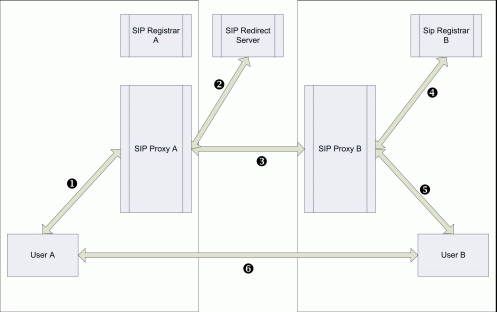
Figure. SIP call flowchart.
-
User A places a call to User B (User B is in a domain external to User A's domain). This request is picked up by SIP proxy A (arrow 1).
-
SIP proxy A determines that User B is outside its domain so asks a SIP redirect server where "User B of domain B" can be found (arrow 2).
-
SIP redirect server responds with the address for SIP server B (arrow 2).
-
SIP proxy A sends the call request to SIP server B (arrow 3).
-
SIP server B requests the location of User B from SIP registrar B (arrow 4).
-
SIP registrar B responds with User B's location (arrow 4).
-
SIP proxy B contacts User B's device (arrow 5).
-
User B accepts the call.
-
User B's device tells SIP proxy B (arrow 5).
-
SIP proxy B tells SIP proxy A (arrow 3).
-
SIP proxy A tells User A's device (arrow 1).
-
Channel is established (arrow 6).

